Fast & Free Shipping
Get FREE delivery in the Republic of Ireland when you spend over €10
Currently Out Of Stock
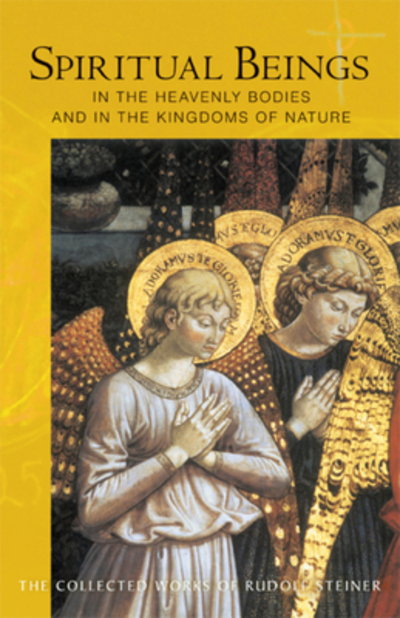
Spiritual Beings in the Heavenly Bodies and in the Kingdoms of Nature
Paperback
€31.13
Collect 93 Reward Points
- Currently Out Of Stock
- Book Synopsis
- <p><b>10 lectures, Helsinki, April. 3-14, 1912 (CW 136)</b></p><p>Rudolf Steiner's achievement in these lectures--it has been said by Valentin Tomberg--"cannot be compared with the accomplishment of any contemporary seer or thinker, or with any of the Middle Ages or antiquity. It towers over them."</p><p>In the architecture of Rudolf Steiner's great cosmological temple, this extraordinary course of lectures on spiritual beings forms the central pillar with other important texts such as the fourth chapter of <i>An Outline of Esoteric Science</i> (CW 13); <i>The Spiritual Hierarchies and the Physical World</i> (CW 136); and <i>Inner Experiences of Evolution</i> (CW 132). These works--outlining a revolutionary angelological cosmology--are at the heart of Steiner's mission to transform our understanding of the world by laying down a new, non-dual, phenomenological path to a contemporary divine-spiritual-physical cosmology that is angelological and theophanic.</p><p>For Steiner, what constitutes the world are "beings"--including the ground of the world itself, the "Father being." Steiner's cosmology or angelology is personal, and it is known in relationship; therefore, he presents it in terms of states and deeds of conscious, and of the divine-spiritual beings whose states and deeds they are. The spiritual world is thus always a world of beings. The twin realizations--<i>I am an "I" being</i> and <i>reality is constituted of other "I" beings</i>--go together. Cosmology is angelology. Spiritual beings define experience of the nature of reality. In these lectures, the reader is led through a series of meditations to recognize these spiritual beings and come to know their deeds.</p><p>Steiner's approach is "contemporary" in that, while continuous with the most ancient understanding of the cosmos, he discovers it for himself, out of his own experience and consciousness, and expresses it in his own words with a logic and language appropriate to our time. Thus, he teaches us, his readers, to do the same. In these lectures, the reader is led through a series of meditations to recognize and come to know the activities and beings of the hierarchies: </p><p><b>FIRST HIERARCHY</b></p><p>Seraphim -- Spirits of Universal Love<br>Cherubim -- Spirits of Harmony<br>Thrones -- Spirits of Will</p><p><b>SECOND HIERARCHY</b></p><p>Kyriotetes -- Spirits of Wisdom / Dominions<br>Dynamis -- Spirits of Motion / Mights or Virtues<br>Exusai -- Spirits of Form / Powers</p><p><b>THIRD HIERARCHY</b></p><p>Archai -- Principalities / Spirits of Personality / Time spirits / Spirits of the Age<br>Archangeloi -- Archangels / Folk Spirits / Spirits of Fire<br>Angeloi -- Angels / Messengers / Spirits of Life or of Twilight</p><p><b>THE HUMAN BEING</b></p><p><b>KINGDOMS OF NATURE</b></p><p>Animal<br>Plant<br>Mineral</p><p>Steiner's achievement in these lectures, as Valentin Tomberg said, "cannot be compared with the accomplishment of any contemporary seer or thinker, or with any of the Middle Ages or antiquity. It towers over them."</p><p>This book is a translation from German of the book <i>Die geistigen Wesenheited in den Himmelskörpern und Naturreichen </i>(GA 136). Translator unknown; original translation revised by Marsha Post.<br></p>
- About The Author
- Rudolf Steiner (1861-1925) was born in the small village of Kraljevec, Austro-Hungarian Empire (now in Croatia), where he grew up. As a young man, he lived in Weimar and Berlin, where he became a well-published scientific, literary, and philosophical scholar, known especially for his work with Goethe's scientific writings. At the beginning of the twentieth century, he began to develop his early philosophical principles into an approach to systematic research into psychological and spiritual phenomena. Formally beginning his spiritual teaching career under the auspices of the Theosophical Society, Steiner came to use the term Anthroposophy (and spiritual science) for his philosophy, spiritual research, and findings. The influence of Steiner's multifaceted genius has led to innovative and holistic approaches in medicine, various therapies, philosophy, religious renewal, Waldorf education, education for special needs, threefold economics, biodynamic agriculture, Goethean science, architecture, and the arts of drama, speech, and eurythmy. In 1924, Rudolf Steiner founded the General Anthroposophical Society, which today has branches throughout the world. He died in Dornach, Switzerland.
- Product Details
-
- ISBN
- 9780880106153
- Format
- Paperback
- Publisher
- Steiner Books, (01 November 2011)
- Number of Pages
- 288
- Weight
- 352 grams
- Language
- English
- Dimensions
- 234 x 156 x 14 mm
- Series:
- See all books in this series
- Categories: